Privacy Policy
ACLU of Massachusetts Privacy Statement
Effective July 1, 2024
The American Civil Liberties Union of Massachusetts, Inc. (“Union”), the ACLU Foundation of Massachusetts, Inc. (“Foundation”), the ACLU Voter Education Fund (collectively, “ACLU of Massachusetts,” “we,” “us,” or “our”) work to expand the right to privacy, increase the control individuals have over their personal information, and ensure civil liberties are enhanced rather than compromised by technological innovation.
ACLU of Massachusetts is committed to living our values by describing, in plain language, how we collect and use your personal information and by providing clear choices for how we collect and use your personal information. We continually evaluate and improve our privacy and data governance practices to responsibly handle personal information entrusted to us. This may include information about you, whether you are an ACLU of Massachusetts supporter or not. We collect information from and about you when you interact with us and we may obtain information about you as an individual member of the public from other sources whether you are an ACLU of Massachusetts supporter or not (e.g., you are a registered voter and we have information about you in voter files we use to conduct voter outreach; research on civil liberties issues, such as, voting rights discrimination; or to identify and better understand potential ACLU of Massachusetts supporters). In this statement “you” refers to both ACLU of Massachusetts supporters and individuals with whom we may not currently have a direct relationship.
This Privacy Statement (“Statement”) describes how ACLU of Massachusetts collects, uses, shares, or otherwise processes personal information in its day-to-day operations. Certain ACLU of Massachusetts programs, as well as “Other ACLU Organizations,” which, along with ACLU of Massachusetts include the American Civil Liberties Union, Inc. and the American Civil Liberties Union Foundation, Inc. (collectively, “National” or “ACLU”), and other ACLU state/local/territory affiliated organizations (ACLU “Affiliates”) throughout the United States have separate privacy statements. Those statements are available here ACLU Organizations Privacy Statements. ACLU of Massachusetts and its affiliated organizations may be referred to individually and collectively as “ACLU Organizations.” To learn more about the scope of this Statement, applicable regulations, and key definitions, read About this Statement.
Privacy Statement Highlights
- Our Data Privacy Principles. ACLU of Massachusetts is committed to your right to privacy. We follow these eight principles when processing your personal information: Transparency, Individual Participation, Purpose Specification, Data Minimization, Use Limitation, Data Quality and Integrity, Security, and Accountability. Learn more.
- Personal Information We Collect. ACLU of Massachusetts collects and stewards personal information about you through a variety of methods, including through direct collection (e.g., through a web form you submit), through automated data collection (e.g., through technologies to understand how people navigate our websites), from third-party sources (e.g., voter information from government and commercial sources), and by inferring personal information about you (e.g., as we look for individuals who may be interested in joining a discrimination lawsuit based on information we have collected from you and/or information acquired from third-party sources). Learn more.
- Why We Use Your Information. ACLU of Massachusetts uses your personal information to further our mission. To better illustrate why we collect this information, we have listed specific processing purposes for which ACLU of Massachusetts uses your information, categorized by the thematic activities of advocacy and organizing; fundraising; legal services; outreach and research; merchandise; services security, optimization, and improvement; and when required by law, to prevent fraud and protect our or others’ rights. Learn more.
- With Whom and How We Share Your Information. ACLU of Massachusetts shares your personal information with our Affiliates, service providers who help us carry out business activities, business partners, and other third parties as required or permitted by law. Learn more.
- With Whom and How We Share Your Information. ACLU of Massachusetts shares your personal information with our Affiliates, service providers who help us carry out business activities, business partners, and other third parties as required or permitted by law. Learn more.
- Your Choices and Rights. ACLU of Massachusetts offers choices on how we process your information. You can let us know how you want us to communicate with you, to correct your information, and ask us to delete or stop using your information in certain ways. Learn more.
Personal Information We Collect
ACLU of Massachusetts collects and stewards your personal information through a variety of methods. This section outlines what information we collect and how we collect it.
Information You Give to Us
This includes information you explicitly take steps to share with ACLU of Massachusetts. This may be through online forms, offline donation and volunteer sign-up forms, or over the phone when you call ACLU of Massachusetts to donate or request Foundation legal assistance, for example. Through these processes, you may share the following categories of information:
- Account registration. For example, account username and password.
- Audio or visual. For example, your image or voice captured when you attend an in-person or virtual event, or leave us a voicemail.
- Contact. For example, email address, postal address, or telephone number.
- Demographic. For example, age, citizenship status, ethnicity/race, or sexual orientation, gender identity, marital or other relationship status, and household information.
- Financial. For example, the amount you plan to bequeath to ACLU of Massachusetts.
- Health. For example, that you have had an abortion or have a disability, and/or other information you provide to us about your health when seeking legal representation, when you tell your story in an ACLU of Massachusetts campaign, and/or when you request an accommodation at an ACLU of Massachusetts event.
- Interaction. For example, purchase and donation history, membership status, and advocacy actions taken.
- Interests. For example, civil liberties or campaigns you are particularly interested in hearing about, or more general information about your personal and professional interests that are relevant to your engagement with ACLU of Massachusetts and our work.
- Jurisdiction. For example, your zip code or county to help us identify your voting district or current representatives.
- Legal. For example, details about conditions of incarceration or other detention that may have violated your civil rights or liberties and that you provide to us when seeking legal representation or to tell your story in an ACLU of Massachusetts campaign.
- Preferences. For example, your preferred method(s) of communication.
- Transaction. For example, credit or debit card details that you provide to make a donation or to purchase ACLU of Massachusetts merchandise.
- User-created content. For example, stories you provide to us as part of our storytelling campaigns or messages on issues we send to your legislative representatives on your behalf. This also includes photos, videos, audio, and other information you may submit to us.
- Other. Any other information you choose to provide, which may include information deemed to be “sensitive” personal information under certain privacy laws, such as religious beliefs, information about your sexual orientation or sex life, or citizenship status.
Information We Automatically Collect
ACLU of Massachusetts and our authorized third parties may use technologies to automatically receive and record information when you interact with us online on our websites and/or through other digital technologies, such as email platforms, mobile applications that link to this Privacy Statement, or over the phone (altogether, “Digital Services”). These technologies allow the ACLU of Massachusetts to improve our Digital Services, to create a better experience for our users, and to protect against fraud.
These technologies may include cookies – small files placed on your browser that can be used to uniquely identify you and record information about the websites you visit – and other technologies, such as web beacons, clear gifs, and single-pixel gifs that use embedded code in our Digital Services to record details about your use of those Digital Services, like whether you opened an email or clicked on a link.
These technologies may be placed by us or by other entities we authorize. We only authorize third parties to place these technologies on our Digital Services if those authorized third parties abide by our confidentiality and security requirements described below under With Whom and How We Share Your Information.
ACLU of Massachusetts and our authorized third parties may automatically collect the following categories of information:
- Contact For example, your email address or telephone number.
- Device identifiers. For example, your phone model, phone carrier browser version, or operating system you use to browse our sites.
- IP address or information that could be derived from it. For example, your approximate geolocation.
- Interaction. For example, the content you click on or view in our e-mails, the amount of time you spend on our websites, or the referring URL.
Information We Receive from Others
ACLU of Massachusetts may acquire personal information about you from third-party sources, such as data cooperatives for nonprofits; other nonpartisan organizations; coalition partners; commercial voter file and consumer research providers; and various federal, state, and local government entities (e.g., public records data or information procured through FOIA requests that we use to search for civil liberties violations). We acquire this information to learn more about you — including how best to engage with you — to identify people like you that may be interested in hearing from ACLU of Massachusetts, and to research and evaluate potential or ongoing claims or advocacy regarding civil rights and civil liberties issues. We may collect the following categories of information from third-party sources:
- Contact. For example, your telephone number, physical and email addresses, or social media handles.
- Demographic. For example, your age, gender and race/ethnicity for assessing the potential disparate impact of laws, learning about the diversity of our supporters and voters to further our commitment to Systemic Equality, and deciding how best to engage people to support our fight against laws that restrict their civil rights, such as stopping bans on abortion.
- Interaction. For example, your engagement with other nonpartisan organizations, nonprofit organizations, and ACLU coalition partners, or your likelihood to support the ACLU of Massachusetts and our issue areas.
- Interests. For example, civil liberties or campaigns you may be interested in hearing about or supporting.
- Financial. For example, estimated household income, real estate or business holdings, or estimated assets and salary, which may include information inferred from publicly and commercially available data for engaging current and identifying prospective donors.
- Jurisdiction. For example, your zip code or county to help us identify your voting district or current representatives.
- Legal. For example, court records, details about conditions of incarceration, or other detention that may have violated your civil rights or liberties.
- Voting. For example, precinct, voter registration, modeled party registration, or information about your history of voting in prior elections.
Information We Infer and Model
ACLU of Massachusetts may use personal information we have collected — directly, automatically, or acquired from third parties — to compile, combine, and infer new information about you. We do this to tailor our communications and outreach, and to improve our programs and services.
ACLU of Massachusetts and our service providers may infer the following categories of information:
- Contact. For example, inferred members of your household.
- Demographic. For example, when we cannot ascertain demographic data directly, we may rely on models or service providers to infer gender or racial/ethnic identity in order to assess the potential disparate impact of laws, learn about the diversity of our supporters and voters to further our commitment to Systemic Equality, and deciding how best to engage people to support our fight against laws that restrict their civil rights, such as stopping bans on abortion.
- Financial. For example, we may use models or service providers to estimate the amount you are likely to donate.
- Interaction. For example, inferred likelihood to engage with the ACLU of Massachusetts and our issue areas.
- Interests. For example, civil liberties or campaigns you may be interested in hearing about or supporting.
- Preferences. For example, your preferred method(s) of communication.
- Voting. For example, inferred likelihood to vote based on an issue area.
Information We Infer and Model
ACLU of Massachusetts may use personal information we have collected — directly, automatically, or acquired from third parties — to compile, combine, and infer new information about you. We do this to tailor our communications and outreach, and to improve our programs and services.
ACLU of Massachusetts and our service providers may infer the following categories of information:
- Contact. For example, inferred members of your household.
- Demographic. For example, when we cannot ascertain demographic data directly, we may rely on models or service providers to infer gender or racial/ethnic identity in order to assess the potential disparate impact of laws, learn about the diversity of our supporters and voters to further our commitment to Systemic Equality, and deciding how best to engage people to support our fight against laws that restrict their civil rights, such as stopping bans on abortion.
- Financial. For example, we may use models or service providers to estimate the amount you are likely to donate.
- Interaction. For example, inferred likelihood to engage with the ACLU of Massachusetts and our issue areas.
- Interests. For example, civil liberties or campaigns you may be interested in hearing about or supporting.
- Preferences. For example, your preferred method(s) of communication.
- Voting. For example, inferred likelihood to vote based on an issue area.
Why We Use Your Information
ACLU of Massachusetts collects your personal information to further our mission through our advocacy and organizing, litigation, and fundraising programs. When we process, use, or share that information, we apply appropriate confidentiality and security requirements (see: How We Protect Your Information and With Whom and How We Share Your Information). In addition, we aim to use only the information that is specific and necessary for the ACLU of Massachusetts processing purposes we collected it for (see: Our Data Privacy Principles).
- Advocacy and Organizing. ACLU of Massachusetts works to advance our advocacy and organizing capacity to further our mission. To do this, ACLU of Massachusetts uses the personal information you provide to us when you take action to share your stories and testimonials, to deliver your petitions and action messages, and to host events. We may also use your personal information to mobilize volunteers and activists in support of our work.
- Fundraising. ACLU of Massachusetts, as a nonprofit, needs donor support to enable its operations. To do this, ACLU of Massachusetts uses your personal information to process your donations and solicit donations.
- Legal Services. Foundation works to win court battles and Supreme Court cases core to our issue areas, and to provide other critical legal services regarding important civil liberties and rights to Foundation clients. To do this, ACLU of Massachusetts uses sources that may include your personal information to research violations of civil liberties, evaluate requests for legal representation, solicit potential clients, litigate court cases, and effectively represent Foundation clients.
- Merchandise. ACLU of Massachusetts provides merchandise to support our advocacy and fundraising efforts. When you order merchandise, ACLU of Massachusetts uses your personal information to register your account with our store or process your payments.
- Outreach and Research. ACLU of Massachusetts works to deliver information on issue areas you have identified as important to you and seek out new supporters of our mission. To do this, ACLU of Massachusetts uses your personal information to communicate opportunities to support ACLU of Massachusetts’s mission through various communication channels, including targeted advertising, based on your engagement profile, social listening, and polling.
- Services Security, Optimization, and Improvement. ACLU of Massachusetts works to provide you with a secure and optimized experience engaging with our Digital Services, and to improve our programs and services to advance our work preserving and protecting civil rights and liberties more generally. To do this, ACLU of Massachusetts uses your personal information in: user-experience testing, website performance assessment, fraud detection, account registration, and to conduct internal research to develop and improve our services, products, and technologies.
- When Required by Law, to Prevent Fraud, and Protect Our or Others’ Rights. ACLU of Massachusetts, as a nonprofit, must submit donation reports to governmental entities and fulfill other legal obligations, such as complying with Your Choices and Rights. To do this, ACLU of Massachusetts uses your personal information to fulfill those obligations (e.g., ensuring that your information is deleted from our systems if you so request). In addition, ACLU of Massachusetts may need to use your personal information to prevent fraud or to protect our or others’ rights (e.g., researching your personal information if we have reason to think you may be using our name and logo without permission).
Processing Activities and Uses
There is not a “one-size fits all” approach to how ACLU of Massachusetts processes and uses personal information. ACLU of Massachusetts strives for transparency about what personal information we collect and how we use it. This chart details further our personal information processing activities and their purposes, the categories of personal information we process (see Personal Information We Collect for more information), and the categories of parties with whom we may share your information (see With Whom and How We Share Your Information for more information).
|
Processing Activity and Use
|
Purpose(s)*^
|
Type(s) of Information*
|
With Whom We May Share Information^
|
|
Account creation and management: To create and manage your account. Accounts may be created for our online store.
|
|
|
|
| Broadcast updates and communicate with you: To keep you informed of our priorities and opportunities to get involved, and in response to inquiries made by you. This can be through direct mail, email, phone calls, and text messages and includes any of our action or marketing lists you subscribe to. |
|
|
|
| Conduct research and analyze information to improve the effectiveness of our outreach and communications: To ensure you receive the most relevant opportunities, we use personal information to model and identify who is most likely to support an issue area or campaign and segment our messages. |
|
|
|
| Deliver petitions and other message actions: To facilitate petitions and other message actions to our advocacy targets (such as messages to your member of Congress). |
|
|
|
| Evaluate requests for and provide legal services: To assess requests for legal assistance, potential and pending legal action, and to deliver legal services to Foundation clients. |
|
|
|
| Host our National Advocacy Institute and other events: To plan and host in-person or virtual events, including selecting participants, awarding scholarships, coordinating travel, lodging, or other accommodations and logistical planning. |
|
|
|
|
Mobilize volunteers: To mobilize volunteers to canvass, phonebank, or text-bank in support of an issue area or campaign.
|
|
|
|
| Participate in data cooperatives and list sharing arrangements to identify prospective ACLU of Massachusetts donors and strengthen support: To grow and strengthen our donor base, we participate in list exchanges with like-minded, nonpartisan organizations, and engage in data cooperatives for nonprofits. |
|
|
|
|
Prevent fraud: To protect ACLU of Massachusetts against fraudulent actors making payments through our sites.
|
|
|
|
|
Process payments: To process your donations or payments for other services such as registering and paying for an ACLU of Massachusetts ticketed event. This includes managing payments, charges, and bequests from estates and financial accounts.
|
|
|
|
Research violations of civil liberties: To research and analyze the impacts of laws, policies, and government or other stakeholder actions. This may be done to prepare and bolster legal claims, ACLU of Massachusetts advocacy campaigns, public education, and/or particular programs. For example:
|
|
|
|
|
Secure and optimize our Digital Services: To make our Digital Services easier, more pleasant to use, and effective by monitoring, assessing, and conducting other research and internal operations to secure, optimize, and improve our services, technology, and products.
|
|
|
|
|
Serve and improve targeted advertising: To deliver advertising to people who are likely to support our issues, and to improve our targeted advertising we may use aggregated ad performance data like views, click, and conversions.
|
|
|
|
|
Solicit requests for legal support: To process solicited and unsolicited requests for legal support. ACLU of Massachusetts may solicit you directly or indirectly as a potential plaintiff if we think you may benefit from our services. You may also decide to contact ACLU of Massachusetts for legal support, in which case, we may process your information to determine if we can help and/or refer you to organizations that can help.
|
|
|
|
|
Storytelling: The ACLU of Massachusetts collects your stories to raise awareness around testimonials of injustice as part of our movement building.
|
|
|
|
| *Special Circumstance: In some instances, we may collect and/or use your personal information in ways not described in this chart. In those instances, we will describe how we will use or share your personal information at the point of collection.
^When Required by Law, to Prevent Fraud, and Protect Our or Others’ Rights: The ACLU of Massachusetts may also use your information to fulfill our legal obligations. Our processing activities may require we share your information with government agencies, law enforcement, or other third-parties, for example as we assess a potential threat you may have made to us. See With Whom and How We Share Your Information. |
|||
In addition to the processing purposes described in this notice, we may also de-identify personal information where possible. We may de-identify existing personal information to proactively minimize the data in our possession when identifying information is no longer needed. We may also de-identify information to remove identifying information from records that must be retained for legal purposes when you request the ACLU of Massachusetts delete your information. When we de-identify information permanently for privacy purposes, we will use it only in its de-identified form and do not attempt to re-identify the information.
How We Protect Your Information
ACLU of Massachusetts has taken physical, technical, and administrative measures to safeguard the information we collect. We work to keep your data safe and protect against unauthorized access to, and improper use of, personal information we collect online.
- Physical measures. For example, your personal information, such as your name and address, is stored on servers subject to physical security safeguards.
- Technical measures. For example, data transmitted to and from our sites, including credit card numbers, are encrypted in transit.
- Administrative measures. For example, we have established privacy and security policies and procedures to limit access to personal information. We also adhere to industry standards and regularly monitor our compliance with Payment Card Industry Standards to protect credit card information that you provide to us.
With Whom and How We Share Your Information
This section provides additional information on how we share your personal information with our state and local Affiliates, service providers, business partners, and other third parties.
We share personal information with your consent, when you direct us to share it with others, as necessary to complete your transactions, or to provide the services you have requested or authorized. For example, when you provide credit card information to donate, we will share that data with payment card processors and other entities as necessary to process your payment and to prevent or detect fraud.
We also share personal information with the following types of other parties:
Our Affiliated Organizations
To maximize our impact nationwide, ACLU of Massachusetts works together with and shares your personal information with our state/local/territory Affiliates around the United States and National to create a coherent experience for our supporters, members, and the public. For example, when you become a member of the National Union, you typically will also become a member of ACLU of Massachusetts’s Union Organization (if the mailing address you provide with your donation is in our state or territory). We also may co-collect or share your personal information with any affiliated ACLU Organizations.
While the ACLU Organizations adhere to a common set of privacy principles and standards for handling personal information that we share with one another, each ACLU Organization may have its own unique data practices that are not contained in this Statement. When we share your personal information with other ACLU Organizations, they are bound to use that information in accordance with their privacy statement and with regard to their own operations. To view the list of all ACLU Organizations’ privacy statements, read ACLU Organizations Privacy Statements.
Service Providers
We work with a variety of service providers who help us process your personal information as outlined in Why We Use Your Information above, such as to facilitate the operation of our sites; support our fundraising, marketing, communications, and advocacy programs; and deliver messages to you on other platforms.
We require these service providers to agree to take reasonable security measures in the handling and storage of that information. When we share personal information about you with a service provider, we take steps to: (1) transmit it in a secure manner and (2) require the service provider to promise to keep that information confidential and use it only for the purpose of carrying out the activities we have directed them to perform.
We allow some service providers to compile and use certain information related to ACLU of Massachusetts and/or its supporters’ use of the services for internal purposes, like improving the functionality or security of the services ACLU of Massachusetts receives from the service provider. In some instances, this may include training the service providers’ artificial intelligence tools or features for the services they provide the ACLU of Massachusetts*. In addition, we may also permit service providers to create and use data that has been de-identified for broader business purposes, including sharing aggregated benchmarking data with their business partners, other customers, or other third parties. We will not agree to that unless the service provider has sufficiently committed to not recombine the data with other information to identify you, and will not share or sell or use any identifiable data about you for the benefit of third parties outside the ACLU of Massachusetts-service provider business relationship.
*ACLU of Massachusetts takes your agency over the use of your personal information seriously. As the artificial intelligence landscape continues to evolve, we are committed to monitoring our service providers’ artificial intelligence tooling for disproportionate privacy risks and other potential threats to civil liberties.
Business Partners
In some cases, we may disclose personal information to our vendors and other business partners for their own business purposes. In exchange, we may receive money or something else of value to ACLU of Massachusetts (e.g., a list of donors or supporters from like-minded organizations whose donors and supporters may also be interested in donating to and supporting ACLU of Massachusetts). We may also share your information with third party business partners at your request. For example, we may share information with another nonprofit advocacy organization with whom we are co-hosting an event or working in broader coalition on important civil liberties issues.
These “Business Partners” include:
- Coalition Partners. To enable more effective advocacy, organizing, and litigation, we often partner with other organizations to further the reach of our work. We may share your personal information with our coalition partners to further those efforts and bolster our respective capacities to pursue our missions. We, however, will only share your personal information if you have requested or consented to have it shared.
- Co-counsel. As needed, ACLU of Massachusetts may share personal information with third parties during litigation, including with co-counsel, referral partners, expert witnesses, and other parties engaged in prospective and pending litigation. Personal Information we share in this context may be related to you or other individuals who are not direct clients depending on the legal matter. For example, we may use modeled voter data that is relevant to a voting rights case against a state government entity. When ACLU of Massachusetts lawyers share personal information, particularly client information, they do so in compliance with applicable professional responsibility rules.
- Data Cooperatives for Nonprofits. To grow our base of donors, ACLU of Massachusetts participates in nonprofit data cooperatives. Data cooperatives are membership-based services offered by vendors that enable cooperative members to pool personal information about their respective supporters to model and identify new prospective supporters and/or to deepen engagement with existing supporters. When we participate in data cooperatives, we may share your personal information, including contact and interaction information — for example, donation history — with data cooperative vendors in exchange for the ability to contact individuals who are prospective ACLU of Massachusetts supporters and/or modeled information about existing ACLU of Massachusetts supporters who also support other cooperative member nonprofits (e.g., modeled information may include likelihood to become a monthly donor to ACLU of Massachusetts). This practice of sharing supporter personal information with and through a data cooperative is a longstanding nonprofit practice that enables nonprofits to maintain a stronger supporter base — while lowering costs — by targeting communications to individuals who are most likely to be interested in hearing from them.
ACLU of Massachusetts will join a data cooperative only if the cooperative exclusively serves nonprofit entities; does not receive any information from the ACLU of Massachusetts about supporters whose information is not already included in the cooperative’s database; does not provide cooperative members direct access to ACLU of Massachusetts-provided information; does not share information derived from ACLU of Massachusetts-provided information to partisan organizations; will not disclose an individual’s ACLU of Massachusetts association to cooperative members; and agrees to remove from the cooperative’s data pool and destroy ACLU of Massachusetts-provided information when we leave the data cooperative. - Nonpartisan Organizations (List Rental or Exchange). To grow our donor base, ACLU of Massachusetts may share your contact information with other nonpartisan organizations, either on a rental basis (i.e., for a monetary fee) and/or in exchange for a similar supporter list from the other nonpartisan organization that ACLU of Massachusetts can contact. This information sharing allows each organization to contact the supporters of the other organization to further its mission. This collaboration is critical to maintaining a strong donor base by lowering costs while reaching the widest possible audience. Data shared with nonpartisan organizations is done on a one-time use basis.
In order to protect your privacy, list-sharing agreements with other nonpartisan organizations are conducted through secure and confidential arrangements in which the external organization does not directly receive information about you unless you choose to engage. Communications generated from list sharing agreements are carried out by each nonpartisan organization’s service provider(s), e.g., a vendor who prepares and sends out a mailer, who keeps your information confidential and secure. The other organization learns information about your relationship with the ACLU of Massachusetts only if you choose to respond to their third-party communication. - Third-party Advertisers. ACLU of Massachusetts may display targeted advertisements to you on non-ACLU platforms, third-party websites, and social media sites, such as Facebook and Instagram, to fundraise and build support for our advocacy, organizing, and litigation priorities. We target our advertisements to effectively and efficiently reach people who are most likely to take action, including people impacted by government policies. In doing so, we may share your personal information with third-party advertisers to serve targeted advertisements to specific individuals (i.e., one-to-one matching), including you, or to display ads to people who are similar to specific individuals (i.e., “look-alikes”) who have engaged with ACLU of Massachusetts. These practices help us engage in effective fundraising and advocacy operations and enable our teams to communicate more effectively with known and prospective supporters.
Personal information shared with these third-party advertisers are hashed to improve privacy. Hashing data refers to the practice of scrambling data in a pre-defined manner to make it more difficult to recognize. We only share hashed data with third-party advertisers that promise to hold ACLU of Massachusetts-provided information confidentially and securely, and promise not to use ACLU of Massachusetts-provided information for other purposes. For additional information on with whom we may have shared your personal information for targeted advertising purposes, please see Third-party Advertisers.
Other Third Parties
We may also share certain personal information with other third parties, as follows:
- Advocacy Targets. To enable more effective advocacy, organizing, and litigation, we may use petitions and other message actions to demonstrate our collective size and strength as ACLU of Massachusetts advocates and organizers to spur change. When collecting signatures for a petition or facilitating other message actions, we may share personal information with advocacy targets (such as messages to your member of Congress).
- Where Requested or Consented to by You (including Public Disclosures) or Necessary to Fulfill Your Request.
- Where Required by Law or Necessary to Protect ACLU of Massachusetts or Others. We may disclose personal information from or about you to third parties in the following circumstances:
- To comply with applicable law or respond to valid legal process, including from law enforcement or other government agencies;
- To conduct litigation, including by disclosing information to co-counsel or ACLU of Massachusetts advisors or other parties involved in the litigation process of claims by or against the ACLU of Massachusetts;
- In the event of exigent circumstances, to help prevent the loss of life or serious injury or to protect the personal safety of ACLU of Massachusetts personnel, users of our Digital Services or other ACLU of Massachusetts services, our visitors, or the public;
- To detect, investigate, prevent or otherwise address fraud or privacy issues;
- To operate and maintain the security of our services, including to detect, investigate, prevent, stop, or remediate an attack on our computer systems or networks; or
- To protect the rights or property of ourselves, our Affiliates, or others, including by enforcing our agreements, terms, and policies.
ACLU of Massachusetts considers individual privacy and government overreach to be serious civil liberties issues. If we are required by law or legal process to share your information with government agencies, law enforcement, or other third parties (e.g., plaintiffs or defendants in a legal action), we will object to legal demands for third-party access to your information that we believe to be improper. In those situations, if it is determined that we are required by law to disclose your data, we will attempt to do so under cover of confidentiality and, as long as we are legally permitted to do so, will also attempt to provide you with notice of the request by whatever method is reasonably practical prior to making the disclosure to give you an opportunity to object to the disclosure. We will not provide such notice, however, if the disclosure is pursuant to our regular government reporting obligations, such as financial disclosures required for tax law compliance.
Your Choices and Rights
The ACLU of Massachusetts offers you a number of choices in relation to your personal information. Further, you may have a legal right to these choices depending on your jurisdiction.
Communication Preferences
We strive to communicate with you according to your preferences. In some instances, you can update your communication preferences directly through the communication channels where we contact you, e.g., by texting or replying “STOP” to unsubscribe from automated recurring text messages from 82623 or by clicking on the “Unsubscribe” link in the footer of our emails.
In other instances, you will need to contact us to update your communication preferences. To make updating your phone and direct mail communication preferences as easy as possible, we have provided three methods:
- Recommended: Communication Preferences web form. We recommend submitting your phone and mail preferences via our Communication Preferences web form to expedite processing.
- Email. Send an e-mail to: ACLUpreferences@ACLU.org.
- Mail. Send a letter to ACLU Membership Department, 125 Broad Street, 18th Floor, New York, NY 10004.
Data Choices
Your Data Choices
The ACLU of Massachusetts offers you several choices in relation to your personal information. These choices may be offered to you as data subject rights required by applicable law. Data subject rights established by law can differ depending on the state or U.S. territory in which you reside and may be subject to legal limitations. The choices that ACLU of Massachusetts offers include:
- Opting out: You have the choice to opt out of certain types of data processing activities.
- Targeted Advertising. You have the choice to opt out of targeted advertising. In the ACLU of Massachusetts context, targeted advertising refers to our practice of sharing your personal information with third-party advertisers to direct advertisements to you.
- Sales of Data. You have the choice to opt out of sales of data. In the ACLU of Massachusetts context, we exchange donor personal information with other nonpartisan organizations and nonprofit data cooperative vendors. When you opt out of sales of data, you will be removed from both practices.
Note: Some consumer privacy laws also afford residents the right to opt out of profiling or automated decision-making with legal or similarly significant impacts. ACLU of Massachusetts does not conduct these activities.
- Correcting what we have: You have the choice to correct the personal information we have about you. We must consider the interests of others, so this is not an absolute right.
- Deleting what we have: You have the choice to request that we delete the personal information we have about you, except information that is required or permitted to be kept in compliance with applicable law and obligations. If any personal information cannot be deleted, we will notify you when your request is complete.
Note: If you choose to delete your personal information from our systems, your membership, donation, advocacy, and volunteer history with the ACLU Organizations will be irreversibly deleted. This will also unsubscribe you from all ACLU Organizations Communications and cancel any recurring donations. You may re-subscribe to ACLU of Massachusetts communications at any time, but doing so will not restore your past history with ACLU Organizations.
Submit a Data Choice Request
You may submit a data choice request to us using the mechanisms below. To make submitting Data Choice Requests as easy as possible, we have provided the following methods:
- Recommended: Your Data Choices web form. We recommend submitting your data choice request(s) via our dynamic Data Choices web form to expedite processing.
- Email. You may submit an opt-out request for targeted advertising or sales of data by emailing privacy@aclu.org.
You may also authorize another party to submit an opt-out request for targeted advertising and/or sales of data or a deletion request on your behalf by having them email privacy@aclu.org.
Further notes on making Data Choice Requests:
- Identity Verification. When you or an authorized agent on your behalf make a request, we will confirm your identity. We may contact you for more information to verify your identity beyond what is included in your initial request. Information collected to verify your identity will never be used for any other purpose than to verify your identity to fulfill your request. To preserve privacy and further equity, we are committed to not using biometrics, social security numbers, or commercial credit bureau information as part of our identity verification process.
- Children. If you are under 13, we do not want your personal information, and you must not provide it to us. If you are a parent or guardian and believe that your child who is under 13 has provided us with personal information, please contact us to have your child’s information removed.
- Appeals. If you would like to make an appeal related to a Data Choice Request, you may do so by emailing privacy@aclu.org.
Manage Your Privacy Online
The internet is not a private place. As you visit websites, use search engines, and conduct business on the internet, many different companies and organizations are gathering information about your online behavior, including your searches, visits, and transactions, and then matching that data with other information about you or leveraging algorithms to predict your behavior. There are some things you can do to prevent your information from being collected. We encourage you to read our blog post Easy Steps Everyone Can Take to Protect Their Digital Privacy to help protect your privacy online.
Like most websites, our sites collect and process a range of information about their visitors to enable functionality and to deliver requested services. In addition to information we automatically collect for our purposes (see Personal Information We Automatically Collect), our Digital Services include links to social media sites, links to other websites operated by third parties (e.g., a registration page for another nonprofit advocacy organization’s event, a third-party payment processor), embedded media (e.g., YouTube videos), and embedded third-party applications that may collect information about you when you choose to interact with them. When you access this content, you are interacting directly with the third parties, whose data collection and other processing activities are governed by their privacy policies, and not by this Statement. When you view embedded media or interact with embedded third-party applications — hosted on other platforms, but viewable through the buttons we provide — you will remain on our sites but you will be interacting with these third party’s online environment. In these instances, we make clear that you are viewing external content when you click on buttons.
How to Disable Cookies
If you would like to reduce the web data collected about you while browsing the internet, you can purge and disable cookies in your web browser.
For your awareness, our sites will still work if you disable cookies in your browser. Please note disabling cookies on your browser may impact the operability of other websites you visit and disabling cookies will not disable other technologies (such as web beacons, clear gifs, and single-pixel gifs), which the ACLU of Massachusetts uses on our sites to support our operations and the security of our sites.
About this Statement
When This Statement Applies
This Statement describes how we treat personal information collected by ACLU of Massachusetts in our general operations. This includes personal information collected online and offline, including through our main website, www.aclum.org, or which is operated by ACLU of Massachusetts and link to this Statement.
Certain ACLU of Massachusetts programs, as well as ACLU of Massachusetts’s other affiliated ACLU Organizations, have separate privacy statements. When a different privacy statement applies, the relevant privacy statement will be posted. To see a full list of ACLU Organizations’ privacy statements, read ACLU Organizations Privacy Statements.
Definitions
“Data Choices” means the choices you have in relation to your personal information. These choices may be offered to you as data subject rights required by law.
“Personal information” means information that identifies, relates to, describes, or can be reasonably linked, directly or indirectly, to a specific human, in a personal capacity. It does not include information that is considered de-identified, anonymous, or aggregated under applicable law or information relating to a person in their employment or professional capacities, including information obtained from or about an ACLU of Massachusetts employee or job applicants looking to work at ACLU of Massachusetts
“Processing” of personal information means any operation, or set of operations, performed manually or automatically on personal information – like the collection, use, organization, structuring, storage, transmission, analysis, retrieval, deletion, or modification of personal information.
Statement Update Procedure
Our Statement is subject to change. We will post updated versions of this Statement here and, if the changes are significant, we will provide a more prominent notice of changes on our website.
Questions about this Statement
If you have any questions regarding this Privacy Statement or our privacy and data governance practices, you can reach our Privacy and Data Governance team by emailing privacy@aclu.org.


Tools
The ACLU of Massachusetts develops interactive tools for users to learn more about and explore government data – including readily available data, data received via public records requests, and data resulting from litigation.
Search Government Drones in Massachusetts (updated)
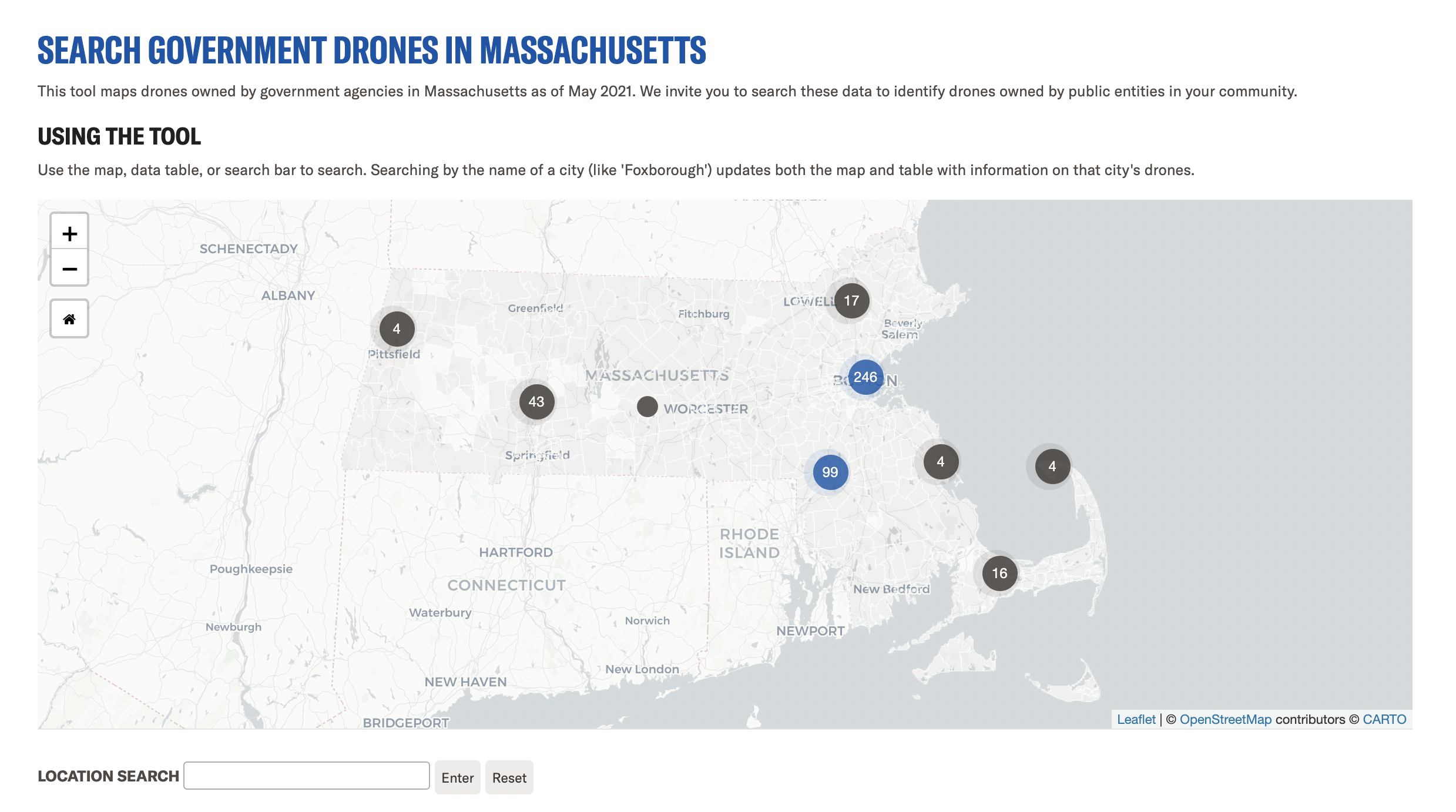
Explore the presence of government-owned drones in Massachusetts, including those owned by law enforcement. The interactive map and table provide information on drone model types, physical locations, and agency ownership. These data were obtained through a May 2021 public records request to the Federal Aviation Administration and include all active FAA licenses for government-owned drones in the state as of that date.
Reviewing Boston Police SWAT Raids 2012-2020
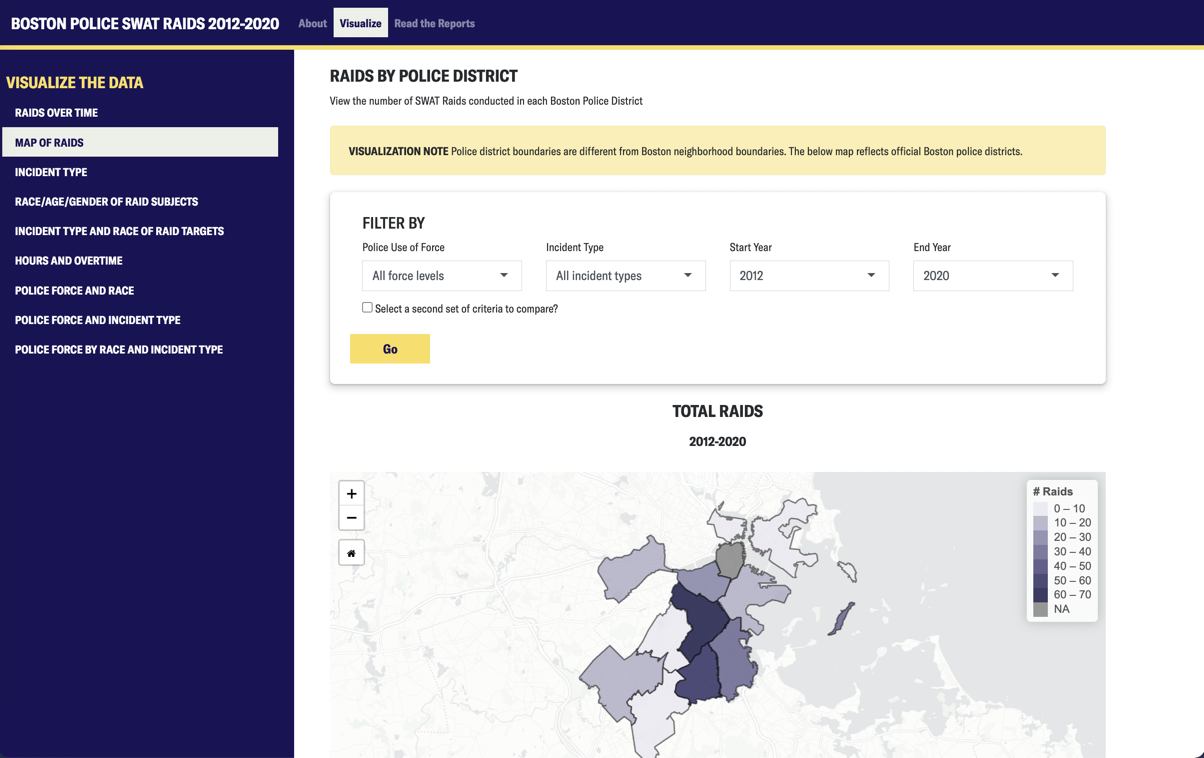
Review, visualize, and analyze after-action incident reports from the Boston Police Department’s SWAT team. This tool includes data from the 262 raids reported between 2012 and May 2020; these records were made publicly available through a 17F order on BPD militarized tactics in the summer of 2020.
(Co)Design the Boston Operating Budget
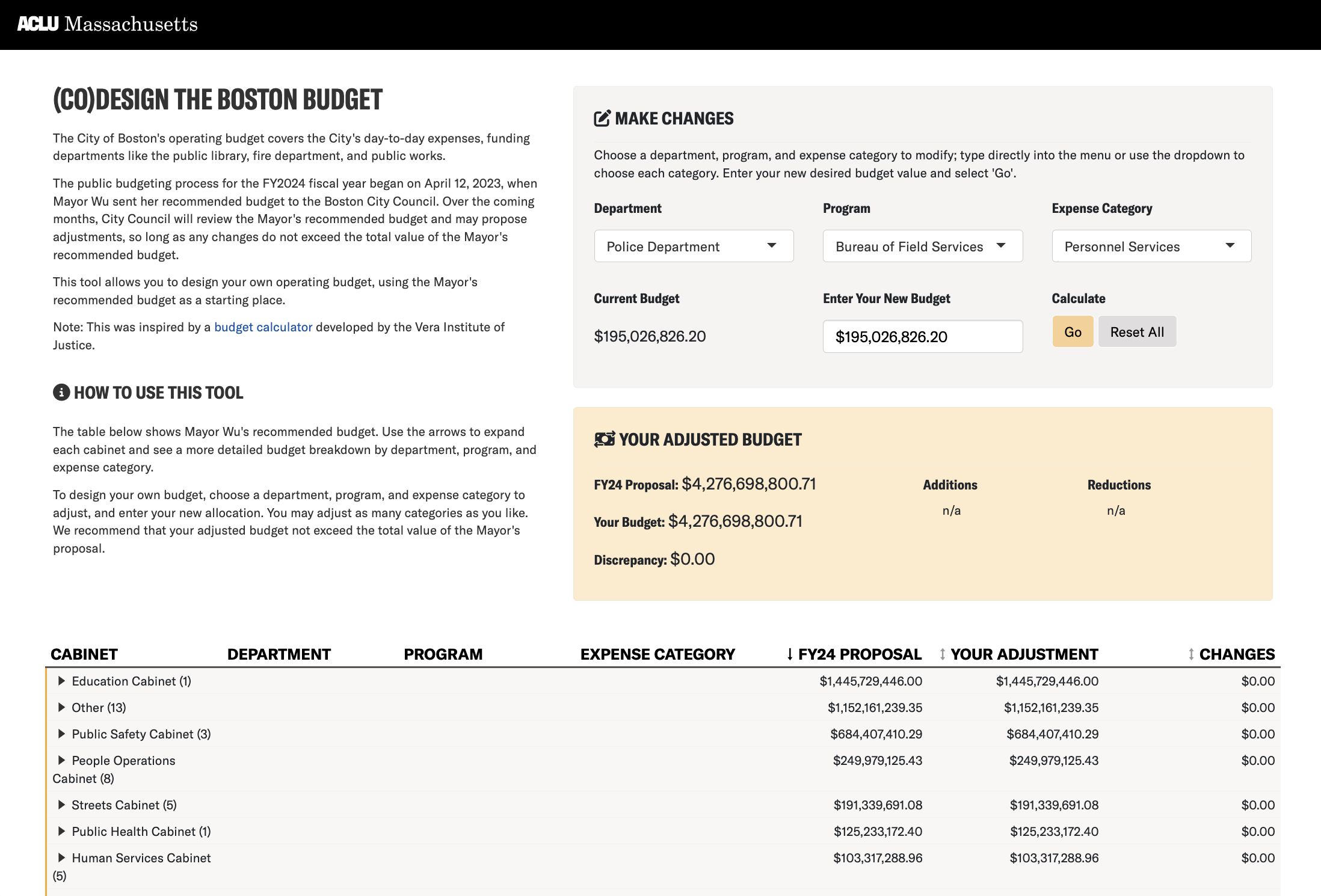
The Boston operating budget covers the city’s day-to-day expenses, funding departments like the public library and fire department. Design your own City of Boston operating budget with this budget calculator, which uses the Mayor’s recommended operating budget for fiscal year 2024 as a starting point.
Documenting Drug Prosecution across Massachusetts
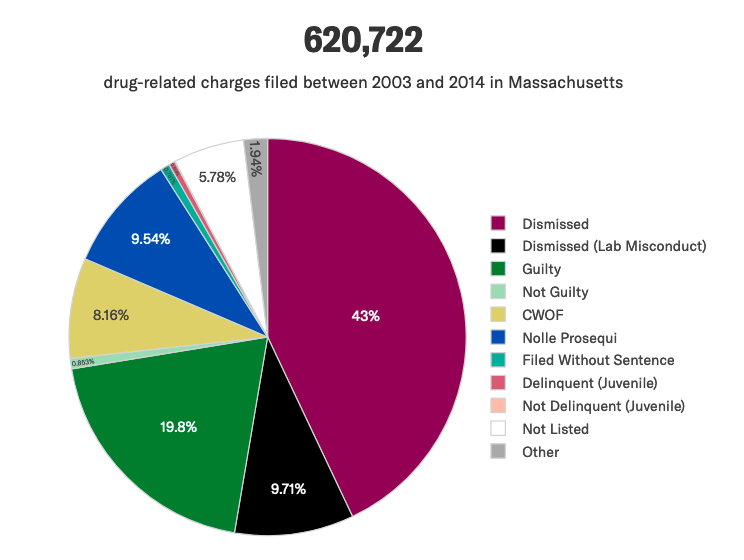
Explore the complete record of drug-related criminal charges filed between 2003 and 2014 and prosecuted under MGL Chapter 94C, as documented in data obtained from the Massachusetts Trial Court. These data are made available as a result of a 2017 lawsuit, brought in response to the misconduct of state drug-lab chemist Sonja Farak and subsequent mishandling by the Massachusetts Attorney General’s Office: Committee for Public Counsel Services (CPCS) v. Attorney General.
Tracking COVID-19 in Massachusetts Prisons & Jails
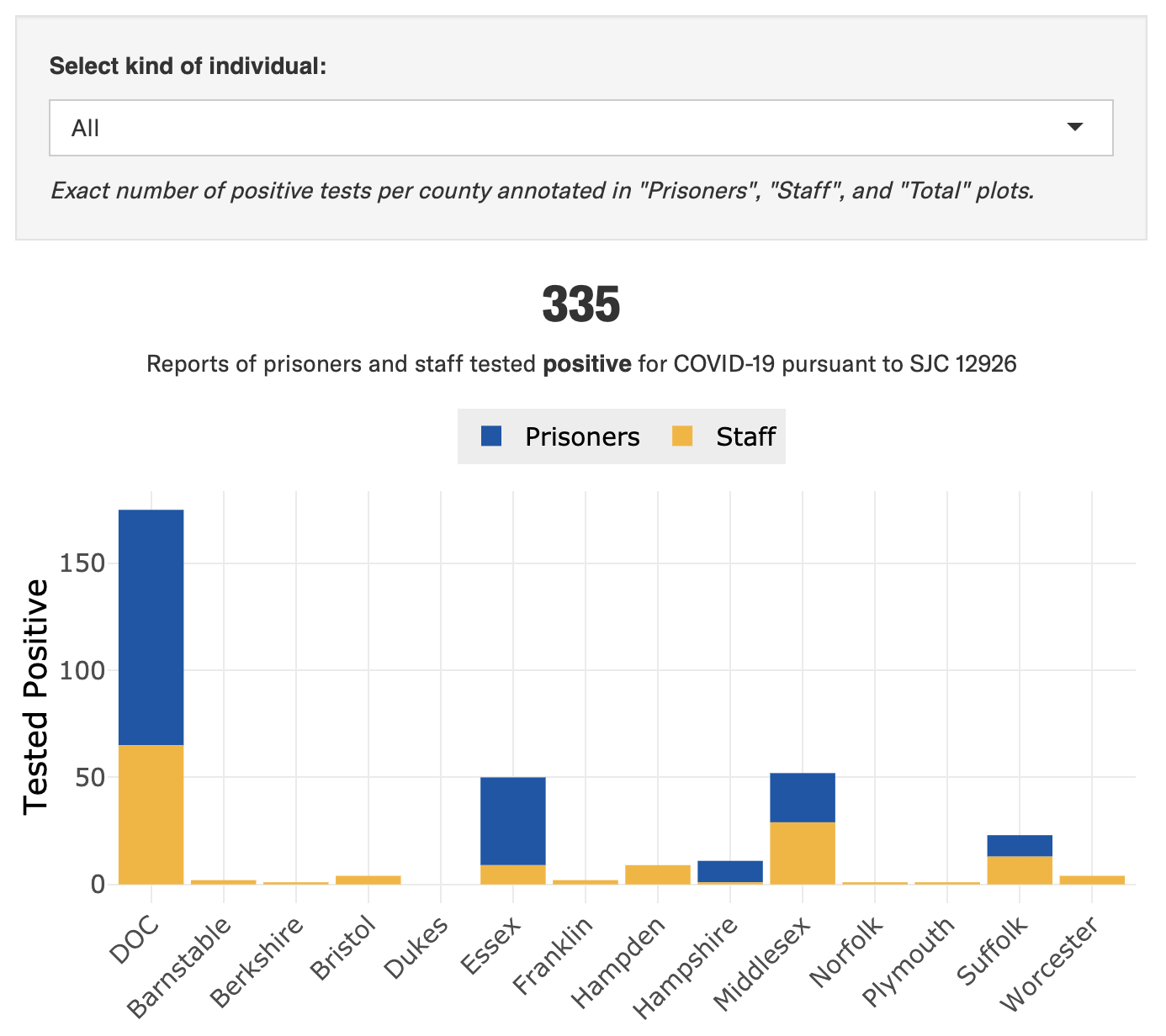
Track testing, positive cases, and releases in prisons and jail during the COVID-19 pandemic, as documented in reports made by Massachusetts prisons and jails to the Supreme Judicial Court (SJC). The data are supplied by county sheriffs and the Massachusetts Department of Correction (DOC) pursuant to the Court’s decision in Committee for Public Counsel Services (CPCS) v. Chief Justice of the Trial Court, SJC-12926.
Mapping Alleged Police Violence & Misconduct
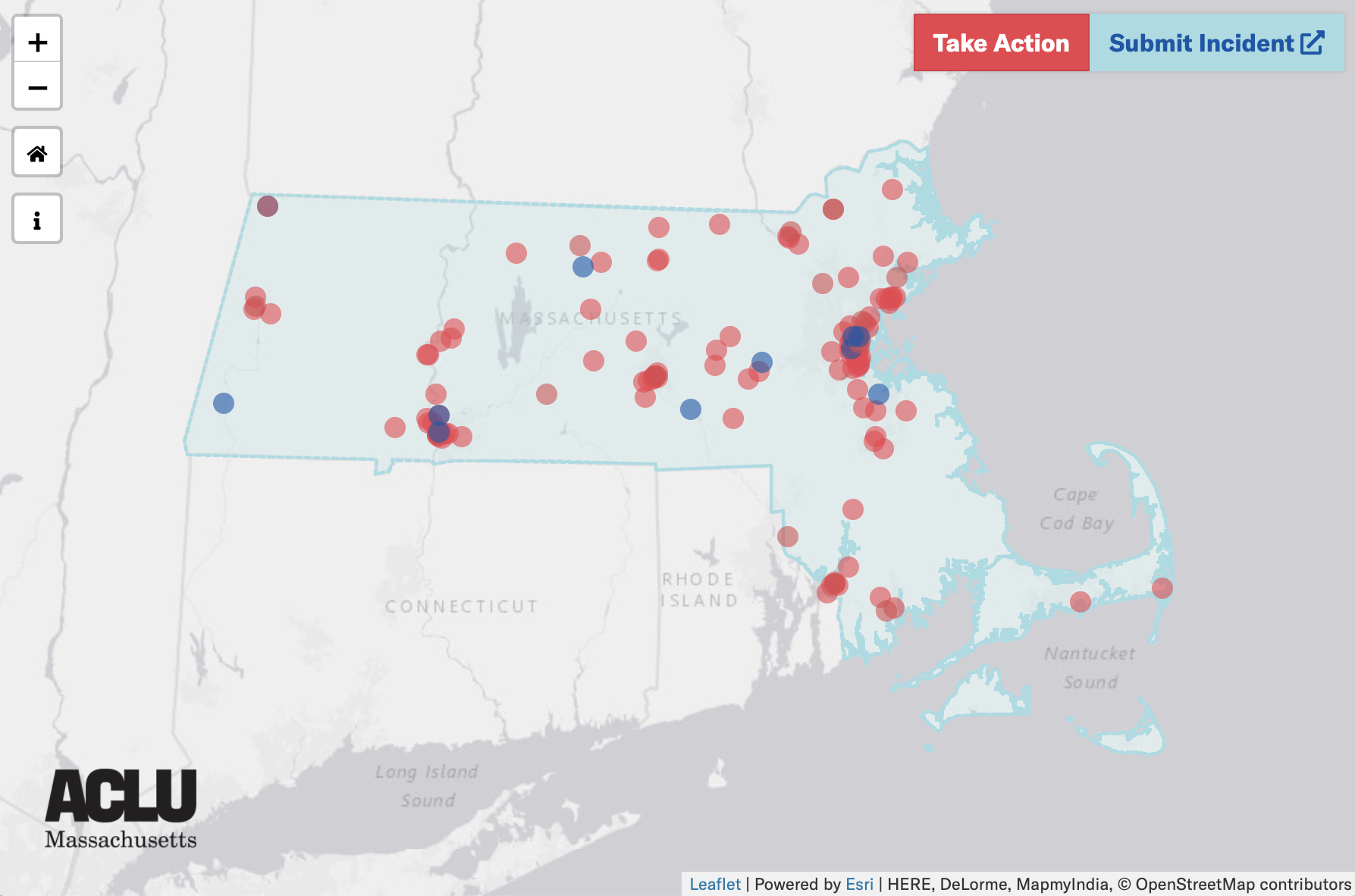
Massachusetts is not immune to police violence and misconduct – and we must demand change. Our map documents incidents of alleged police violence and alleged misconduct that occurred in Massachusetts since 2000, as one portion of our extension Week of Action in support of strong police reform in the Commonwealth.
Tracking Boston Police Incidents
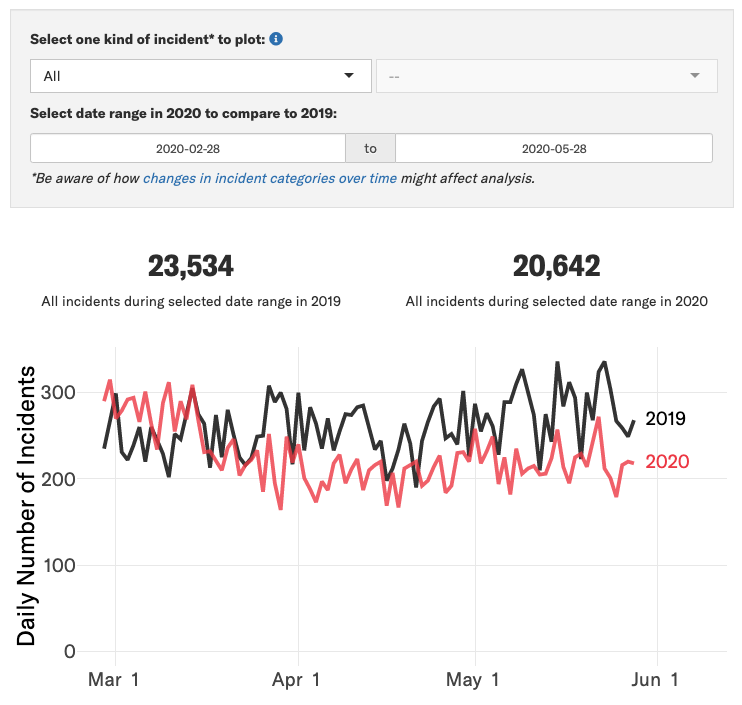
Track the activity of the Boston Police Department over time, including the frequency and location of specific incident types. Police incident reports are publicly available data hosted on Analyze Boston. The reports posted there go back to June 2015, and are (usually) updated daily by the Boston Police.
Police in Politics
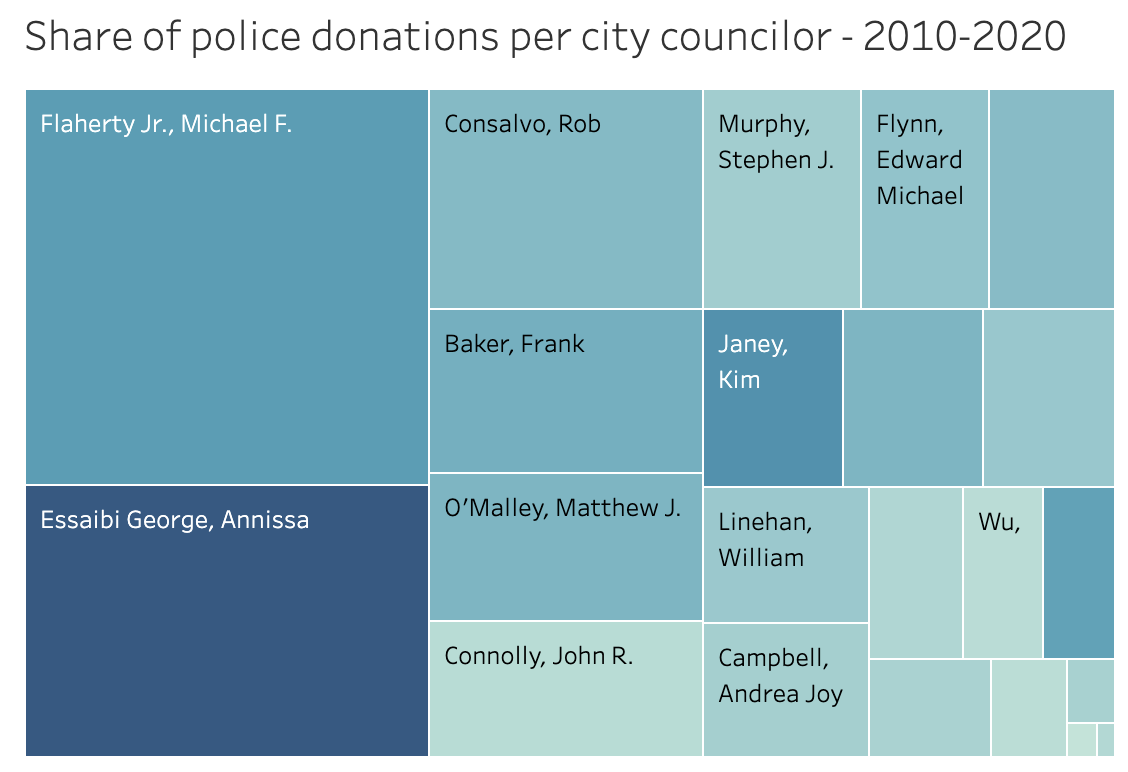
Police reform and budgeting has become a high priority in Boston, across the Commonwealth, and nationally. However, engagement by police staff and their unions in state and local politics often acts as an obstacle to meaningful reform. Trace police-related donations to Mayor Walsh and to the Boston City Council from 2010 to 2020 (up to and including the most recent quarter filing), using data from the Massachusetts Office of Campaign and Political Finance.
Mapping Internet Access in Massachusetts
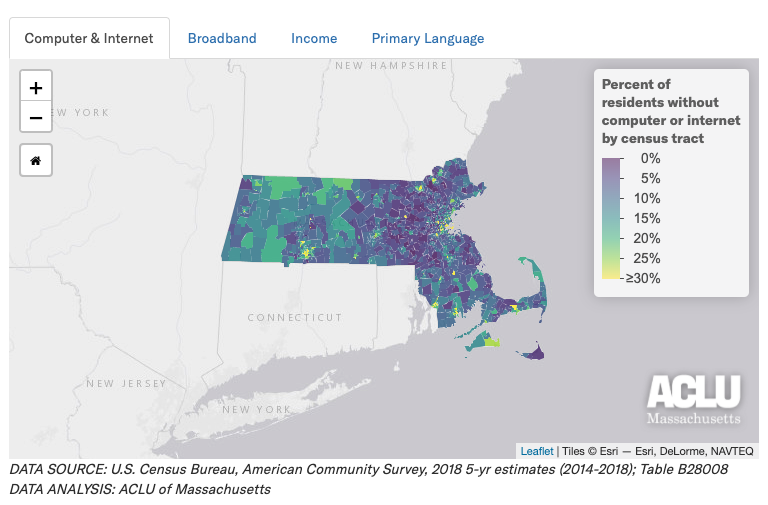
Using data from the Census’ American Community Survey, we map internet and computer access across the Commonwealth. The data show that many urban and rural areas in Massachusetts are “internet deserts”, where access is severely limited.


Reports
The ACLU of Massachusetts regularly publishes reports based on data and documents obtained through the public records law, to inform the public and lawmakers and to advance our civil rights and civil liberties agenda.

Public Records
The ACLU of Massachusetts has filed hundreds of public records requests with various city, state, and federal agencies. On this page, you’ll find requests and responsive documents. These are public records, so please use them however you see fit.
Special Collections

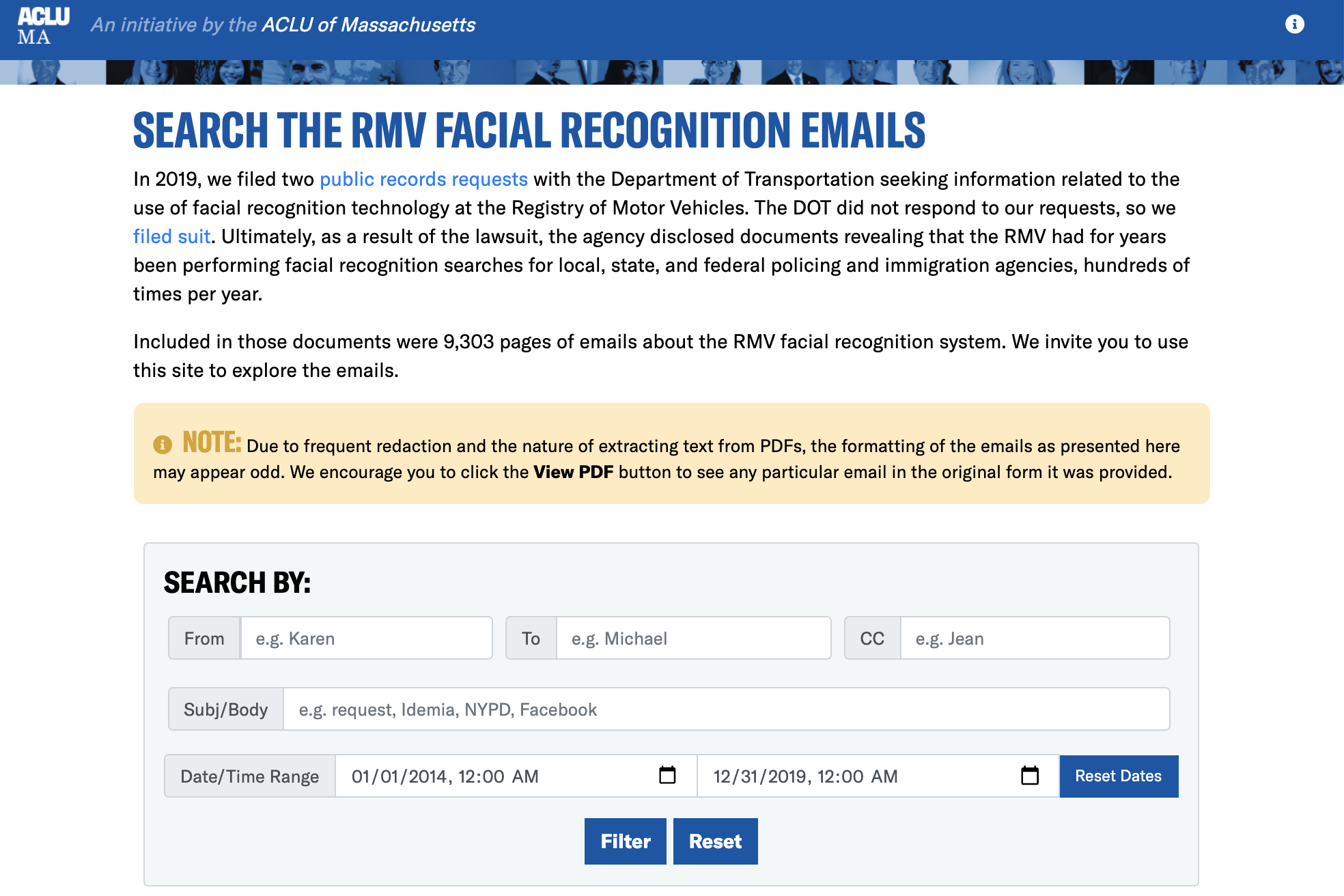
All Requests
Click on a title to learn more about a particular request. Use the arrows and the search bar to help narrow your search
| Title | Submitted To | Category | Number of Documents | Year Filed | Date Published |
|---|---|---|---|---|---|
| Lantel at the Boston Office of Emergency Management | Boston Office of Emergency Management | Surveillance | 266 | 2019 | 2/26/21 |
| Lantel at the Executive Office of Health and Human Services | Executive Office of Health and Human Services | Surveillance | 1 | 2019 | 2/26/21 |
| Lantel at the Executive Office of Public Safety and Security | Executive Office of Public Safety and Security | Surveillance | 2 | 2019 | 2/26/21 |
| Lantel at the Executive Office for Administration and Finance | Executive Office for Administration and Finance | Surveillance | 0 | 2019 | 2/26/21 |
| Lantel at the Massachusetts Bay Transit Authority (MBTA) | Massachusetts Bay Transit Authority (MBTA) | Surveillance | 2 | 2019 | 2/26/21 |
| Lantel at the Massachusetts State Police | Massachusetts State Police | Surveillance | 14 | 2019 | 2/26/21 |
| DataWorks at the Executive Office of Public Safety and Security | Executive Office of Public Safety and Security | Surveillance | 7 | 2019 | 2/26/21 |
| Morpho at the Executive Office of Health and Human Services | Executive Office of Health and Human Services | Surveillance | 2 | 2019 | 2/26/21 |
| IBM at the Springfield Police Department | Springfield Police Department | Surveillance | 2 | 2020 | 2/26/21 |
| Briefcam at the City of Boston (2019) | City of Boston | Surveillance | 7 | 2019 | 2/26/21 |
| MA Police Departments Receiving Solicitations from Clearview AI | Various Police Departments | Surveillance | 102 | 2020 | 2/26/21 |
| MA Police Departments with No Records from Clearview AI | Various Police Departments | Surveillance | 445 | 2020 | 2/26/21 |
| Clearview AI at the Agawam PD | Agawam PD | Surveillance | 3 | 2020 | 2/26/21 |
| Clearview AI at the Andover PD | Andover PD | Surveillance | 4 | 2020 | 2/26/21 |
| Clearview AI at the Boston PD | Boston PD | Surveillance | 0 | 2020 | 2/26/21 |
| Clearview AI at the Beverly PD | Beverly PD | Surveillance | 1 | 2020 | 2/26/21 |
| Clearview AI at the Marlborough PD | Marlborough PD | Surveillance | 1 | 2020 | 2/26/21 |
| Clearview AI at the Salem PD | Salem PD | Surveillance | 3 | 2020 | 2/26/21 |
| Clearview AI at the Somerset PD | Somerset PD | Surveillance | 2 | 2020 | 2/26/21 |
| Clearview AI at the Wellesley PD | Wellesley PD | Surveillance | 3 | 2020 | 2/26/21 |
| Clearview AI at the Yarmouth PD | Yarmouth PD | Surveillance | 1 | 2020 | 2/26/21 |
| Clearview AI at the Bourne PD | Bourne PD | Surveillance | 1 | 2020 | 2/26/21 |
| Clearview AI at the Dalton PD | Dalton PD | Surveillance | 0 | 2020 | 2/26/21 |
| Clearview AI at the Falmouth PD | Falmouth PD | Surveillance | 4 | 2020 | 2/26/21 |
| Clearview AI at the Great Barrington PD | Great Barrington PD | Surveillance | 0 | 2020 | 2/26/21 |
| Clearview AI at the Harvard PD | Harvard PD | Surveillance | 1 | 2020 | 2/26/21 |
| Clearview AI at the Norfolk Sheriff's Office | Norfolk Sheriff's Office | Surveillance | 0 | 2020 | 2/26/21 |
| Clearview AI at the Oxford PD | Oxford PD | Surveillance | 3 | 2020 | 2/26/21 |
| Clearview AI at the Sudbury PD | Sudbury PD | Surveillance | 2 | 2020 | 2/26/21 |
| Clearview AI at the West Bridgewater PD | West Bridgewater PD | Surveillance | 11 | 2020 | 2/26/21 |
| Clearview AI at the Foxbourugh PD | Foxbourugh PD | Surveillance | 1 | 2020 | 2/26/21 |
| Clearview AI at the Massachusetts State Police (MSP) | Massachusetts State Police (MSP) | Surveillance | 5 | 2020 | 2/26/21 |
| Briefcam at the City of Boston (2020) | City of Boston | Surveillance | 3 | 2020 | 2/26/21 |
| COPLINK Facematch at the Massachusetts State Police | Massachusetts State Police (MSP) | Surveillance | 1 | 2019-2020 | 2/26/21 |
| EOPSS Grants for Surveillance Tech in MA Schools | Executive Office of Public Safety and Security | Surveillance | 2 | 2019 | 2/26/21 |
| Face Recognition in MA Schools | Various School Districts | Surveillance | 1 | 2019 | 2/26/21 |
| Face Recognition in Revere Public Schools | Revere Public Schools | Surveillance | 23 | 2019 | 2/26/21 |
| Face Recognition at the Department of Criminal Justice Information Services (DCJIS) | Department of Criminal Justice Information Services (DCJIS) | Surveillance | 4 | 2019 | 2/26/21 |
| Face Recognition at the Executive Office of Public Safety and Security | Executive Office of Public Safety and Security | Surveillance | 1 | 2019 | 2/26/21 |
| Face Recognition at the Massachusetts State Police (MSP) | Massachusetts State Police (MSP) | Surveillance | 7 | 2018 | 2/26/21 |
| Known Use of Face Recognition at the Massachusetts State Police (MSP) | Massachusetts State Police (MSP) | Surveillance | 7 | 2019 | 2/26/21 |
| Massachusetts State Police (MSP) Use of Face Recognition at the Registry of Motor Vehicles (RMV) | Massachusetts State Police (MSP) | Surveillance | 1 | 2019 | 2/26/21 |
| Face Recognition at the MA Sheriff's Association [2019] | MA Sheriff's Association | Surveillance | 1 | 2019 | 2/26/21 |
| Face Recognition at the MA Sheriff's Association [2018] | MA Sheriff's Association | Surveillance | 0 | 2018 | 2/26/21 |
| Face Recognition at the Massachusetts Bay Transit Authority (MBTA) | Massachusetts Bay Transit Authority (MBTA) | Surveillance | 0 | 2018-2019 | 2/26/21 |
| Face Recognition at the Department of Transportation (DOT) | Department of Transportation (DOT) | Surveillance | 380 | 2019 | 2/26/21 |
| Face Recognition at the Executive Office of Health and Human Services | Executive Office of Health and Human Services | Surveillance | 0 | 2019 | 2/26/21 |
| Face Recognition at the Department of Criminal Justice Information Services (DCJIS) | Department of Criminal Justice Information Services (DCJIS) | Surveillance | 0 | 2019 | 2/26/21 |
| Massachusetts State Police Access to Fusion Center Booking Database | Massachusetts State Police (MSP) | Surveillance | 4 | 2017 | 2/26/21 |
| MA Police Departments with No Records on Face Recognition (2018-2019) | Various Police Departments | Surveillance | 26 | 2018-2019 | 2/26/21 |
| Facial Recognition at the Cambridge PD | Cambridge PD | Surveillance | 1 | 2018 | 2/26/21 |
| Facial Recognition at the Medford PD | Medford PD | Surveillance | 2 | 2019 | 2/26/21 |
| Facial Recognition at the New Bedford PD | New Bedford PD | Surveillance | 1 | 2018 | 2/26/21 |
| Facial Recognition & COPLINK at the Northampton PD | Northampton PD | Surveillance | 8 | 2019 | 2/26/21 |
| Suspect Technologies and the Plymouth PD | Plymouth PD | Surveillance | 1 | 2018 | 2/26/21 |
| Facial Recognition at the Plymouth PD | Plymouth PD | Surveillance | 0 | 2019 | 2/26/21 |
| Facial Recognition at the Revere PD | Revere PD | Surveillance | 5 | 2018 | 2/26/21 |
| Facial Recognition at the Salem PD | Salem PD | Surveillance | 2 | 2019 | 2/26/21 |
| Facial Recognition at the Springfield PD | Springfield PD | Surveillance | 14 | 2019 | 2/26/21 |
| Facial Recognition at the Peabody PD | Peabody PD | Surveillance | 1 | 2019 | 2/26/21 |
| Location of Surveillance Cameras Across Boston | City of Boston | Surveillance | 0 | 2019 | 2/26/21 |
| Video Surveillance Data Sharing in Boston | City of Boston | Surveillance | 1 | 2019 | 2/26/21 |
| Boston Security Camera Strategy Meetings | City of Boston | Surveillance | 1 | 2019 | 2/26/21 |
| Federal Funds for the BRIC and OEM | City of Boston | Law Enforcement | 32 | 2020 | 7/22/20 |
| DEA and FBI Face Surveillance Records | Federal & State Law Enforcement | Surveillance | Ongoing production | 2019 | 6/17/20 |
| MA Dept. of Public Health COVID-19 Response | Massachusetts Department of Health | Public Health | 5 | 2020 | 5/7/20 |
| Face Recognition in Revere Public Schools | Revere Public Schools | Surveillance | 22 | 2019 | 2/19/20 |
| State Audit of Bristol Sheriff | Bristol County Sheriff’s Office | Law Enforcement | 1069 | 2019 | 12/5/19 |
| Use of Robotics in Law Enforcement | Massachusetts State Police | Law Enforcement | 7 | 2019 | 11/25/19 |
| Boston Police Department Collaboration with ICE | Boston Police Department | Immigration | 10 | 2019 | 10/26/19 |
| Towing Profits by Massachusetts Dept. of Public Utilities | Massachusetts Department of Public Utilities | Law Enforcement | 10 | 2019 | 9/27/19 |
| Surveillance Cameras and Associated Technologies in the Metro Boston Area | Boston Office of Emergency Management | Surveillance | 2 | 2019 | 9/4/19 |
| Records Regarding Face Surveillance Technology | Northampton Police Department | Surveillance | 15 | 2019 | 6/27/19 |
| Minutes from Boston Area Homeland Security Meetings | Boston Metro Homeland Security Region | Law Enforcement | 25 | 2018 | 6/25/19 |
| Plymouth Police Face Surveillance Emails | Plymouth Police Department | Surveillance | 3 | 2018 | 5/6/19 |
| SWAT Team Deployments ↗ | Northeastern Massachusetts Law Enforcement Council | Law Enforcement | 119 | 2012 | 3/18/19 |
| Boston Police Filming Protesters at BPDA meeting | Boston Police Department | Surveillance | 2 | 2017 | 7/19/18 |
| Massachusetts Use of Facial Recognition Technology | Massachusetts State Police | Surveillance | 6 | 2017 | 7/19/18 |
| New Bedford Field Interrogation and Observation Reports | New Bedford Police Department | Law Enforcement | 17 | 2015 | 7/19/18 |
| Social Media Monitoring by Boston Police | Boston Police Department | Surveillance | 3 | 2016 | 7/10/18 |
| Administrative Subpoena Use by District Attorneys | Various Commonwealth District Attorney's | Surveillance | 31 | 2017 | 7/9/18 |
| Drone Use by Boston Police Department | Boston Police Department | Surveillance | 4 | 2017 | 7/9/18 |
| Info about First Responder Network Authority | Massachusetts Executive Office of Public Safety & Security | Surveillance | 15 | 2015 | 6/19/18 |
| Short-Term Detention and Cooperation with CBP and DHS | Wilmington Police Department | Law Enforcement | 7 | 2015 | 6/19/18 |
| Info about Metropolitan Law Enforcement Council | Metropolitan Law Enforcement Council | Law Enforcement | 9 | 2015 | 6/19/18 |
| Regional Interagency Mutual Aid Organizations Between Law Enforcement | Various Commonwealth Police Departments | Law Enforcement | 12 | 2014 | 6/19/18 |
| Mass DOT's Use of Facial Recognition Technology | Massachusetts Executive Office of Transportation | Surveillance | 6 | 2014 | 6/19/18 |
| Administrative Subpoena Use Across the Commonwealth | Attorney General & District Attorney Offices | Surveillance | 44 | 2013 | 6/19/18 |
| National Guard Resources and Records | Massachusetts National Guard | Law Enforcement | 5 | 2013 | 6/19/18 |
| Relationship Between Police and Drug Enforcement Administration | Various Commonwealth Police Departments | Law Enforcement | 15 | 2013 | 6/19/18 |
| Procurement for Urban Areas Security Initiative | Boston Office of Emergency Management | Surveillance | 29 | 2013 | 6/19/18 |
| Information about Joint Terrorism Task Force and Todashev Case | FBI | Law Enforcement | 34 | 2013 | 6/19/18 |
| Information about Joint Terrorism Task Force & Todashev Case | US Attorney for Massachusetts | Law Enforcement | 29 | 2013 | 6/19/18 |
| SWAT & Special Ops Deployment History | Various Commonwealth Police Departments | Law Enforcement | 38 | 2013 | 6/12/18 |
| Surveillance Technology in Schools | Various Commonwealth Public Schools | Surveillance | 28 | 2010 | 6/12/18 |
| Asset Forfeiture by Suffolk County District Attorney | Suffolk District Attorney | Law Enforcement | 9 | 2015 | 6/11/18 |
| Passenger Tracking Information | MBTA & Transit Police | Surveillance | 13 | 2012 | 6/11/18 |
| Information About DoD 1033 Program | Massachusetts State Police | Law Enforcement | 7 | 2012 | 6/11/18 |
| Use of Administrative Subpoenas | Various Commonwealth District Attorney's | Law Enforcement | 57 | 2011 | 6/11/18 |
| Use of Automatic License Plate Readers | Massachusetts Executive Office of Public Safety & Security | Law Enforcement | 66 | 2011 | 6/11/18 |
| Surveillance of Protected Activity | Boston Police Department | Law Enforcement | 8 | 2011 | 6/11/18 |
| Obtaining Historical Cell Phone Location Data | Various Commonwealth Police Departments | Surveillance | 17 | 2011 | 6/11/18 |
| Use of Facial Recognition Technologies | Various Commonwealth Police Departments | Law Enforcement | 38 | 2010 | 6/11/18 |
| TSA Use of Screening Technologies | Transportation Security Administration | Surveillance | 52 | 2010 | 6/11/18 |
| Purchase Info from Urban Areas Security Initiative (UASI) | Office of Emergency Preparedness | Law Enforcement | 46 | 2010 | 6/11/18 |
| Information About the Joint Terrorism Task Force | US Attorney for Massachusetts | Law Enforcement | 89 | 2009 | 6/11/18 |
| EOPSS Fusion Center Intelligence Sharing Information | Massachusetts Executive Office of Public Safety & Security | Law Enforcement | 9 | 2010 | 6/11/18 |
| EOPSS Fusion Center Information | Massachusetts Executive Office of Public Safety & Security | Law Enforcement | 49 | 2005 | 6/11/18 |
| Officer Barry Flanders & Cooperation with the JTTF | Federal & State Law Enforcement | Law Enforcement | 0 | 2002 | 6/11/18 |
| CBP Title 42 Expulsions | U.S. Customs and Border Protection | Immigration | 5 | 2021 | 10/1/21 |
| Plymouth County Sheriffs Department Records | Plymouth County Sheriffs Department | Law Enforcement | 33 | 2021 | 1/10/22 |
| Department of Unemployment Assistance: Use of Facial Recognition and ID.me | Department of Unemployment Assistance | Surveillance | 24 | 2021 | 1/26/22 |
| Drone use by Massachusetts State Police | Massachusetts State Police | Surveillance | 132 | 2021 | 12/19/22 |

Data
In the table below, find data sets related to criminal justice, public spending, and more. Click the name to learn more about each dataset, visit the corresponding public records request (if applicable), and download the data files for your own analysis.
In addition to data obtained by the ACLU, we’ve included links to relevant external sources of information.
| Name | Data Origin | Year Published | Category | Data Host |
|---|---|---|---|---|
| National Police Scorecard ↗ | Various (FBI, Bureau of Justice Statistics, US Census Bureau...) | 2021 | Law Enforcement | Police Scorecard |
| Massachusetts Crime Statistics ↗ | Massachusetts Executive Office of Public Safety and Security | 2020 | Law Enforcement | MA EOPSS |
| Woke Windows: A Comprehensive Database on the Boston Police ↗ | Various | 2020 | Law Enforcement | Woke Windows Project |
| Massachusetts Traffic Citations 2014-2019 (Temporarily Removed) | Massachusetts Department of Transportation | 2020 | Law Enforcement | Data for Justice |
| 2013-14 Suffolk County Prosecution Data | Suffolk County District Attorney's Office | 2019 | Law Enforcement | Data for Justice |
| Massachusetts State Spending ↗ | Comptroller of the Commonwealth of Massachusetts | 2019 | Fiscal management | MA Comptroller |
| City of Boston Spending ↗ | City of Boston | 2019 | Fiscal management | Analyze Boston |
| Stanford Open Policing Project ↗ | Stanford Computational Policy Lab | 2019 | Law Enforcement | Stanford Open Policing Project |
| Boston Police Crime Incident Reports ↗ | Boston Police Department | 2018 | Law Enforcement | Analyze Boston |
| Data from Social Media Monitoring by Boston Police | Boston Police Department | 2018 | Surveillance | Data for Justice |
| Department of Defense 1033 Program | Defense Logistics Agency | 2018 | Law Enforcement | Data for Justice |
| Police Arrest Data for Commonwealth of Massachusetts | Massachusetts Police Departments | 2018 | Law Enforcement | Data for Justice |
| Field, Interrogation, Observation Reports ↗ | Boston Police Department | 2017 | Law Enforcement | Analyze Boston |
| MA Precinct-Level Election Returns | Massachusetts Secretary of State, Elections Division | 2022 | Elections | Data for Justice |
Contact the Data for Justice Project
Please note that we cannot guarantee to provide you with legal services or advice. If you would like to submit an intake request to be viewed by our attorneys, please call (617) 482-3170 between the hours of 9AM and 5PM ET on business days. If you leave a message after hours, someone will get back to you. Thank you.

About the Data for Justice Project
The Data for Justice Project is an initiative by the ACLU of Massachusetts that aims to make data actionable, empowering lawyers, advocates, community organizers, journalists, activists, and the general public by:
- liberating government data sets and making them available in digestible formats;
- publishing documents obtained through ACLU of Massachusetts public records and Freedom of Information Act requests;
- advocating for open government at the municipal, county, and state levels;
- developing tools and dashboards to make complex data sets accessible to ordinary people; and
- using data to tell stories to advance the ACLU of Massachusetts’ legislative advocacy.
Making real the promise of open government in the digital age
Government transparency is a hallmark of a free, open, and democratic society. In a democracy, the people rule. But it’s hard to advocate for reforms or policy changes when we don’t know what our government is doing. We can’t manage what we don’t measure.
We hope the Data for Justice Project will arm activists, advocates, journalists, policy makers, and elected officials with relevant, timely information about how government functions—so we can fix it when it doesn’t.
Why data matters
A few years ago, the Massachusetts state legislature embarked on an ambitious project to reform the criminal legal system. Legislators were moved by personal stories of injustice, and also by data that revealed the systemic nature of these injustices.
Although Massachusetts incarcerates fewer people per capita than most other states, we have a higher incarceration rate than most countries in the world, and among the worst racial disparities anywhere on earth. These depressing data points helped to move the legislature to take bold action to pass omnibus criminal justice reform that, among other things, eliminated mandatory minimum sentencing for certain drug offenses.
Also tucked in to the omnibus criminal justice reform law was an open data measure backed by the ACLU, mandating that the state Executive Office of Public Safety and Security collect arrest data from every police department statewide, and publish it on a regular basis on the state’s website.
That reform is critical, because despite progress, we still don’t know nearly enough about what our government is doing, especially regarding criminal legal system information about arrests, prosecutions, incarceration, and probation and parole.
Even when we can get our hands on data from the criminal legal system, the information is often messy and difficult to work with — sometimes even locked inside PDF files that need to be OCRed or transcribed by hand into a usable format.
Contributions
The Data for Justice Project is a community resource and public education platform. We encourage data scientists, activists, and others to submit analyses of data sourced from this website, and recommend data sets we should include here. Submission does not guarantee publication. But if your work is compelling, we will work with you to give it a home. For more information, or to get involved, please contact the ACLU of Massachusetts Data for Justice Project at data [at] aclum [dot] org.
Special thanks to Paola Villarreal, who as a Technology Fellow worked with the ACLU of Massachusetts to develop the concept of the Data for Justice Project.
Special Thanks

Home Page
Data for Justice is a project of the ACLU of Massachusetts. We hope the project will arm activists, advocates, journalists, policy makers, and elected officials with relevant, timely information about how government functions—so we can fix it when it doesn’t.
Government transparency is a hallmark of a free, open, and democratic society. In a democracy, the people rule. But it’s hard to advocate for reforms or policy changes when we don’t know what our government is doing.
Learn more about Data for Justice.
We can’t manage
what we don’t measure.
6
interactive tools
113
public records requests
12
reports
13
data sets